Wale Okediran
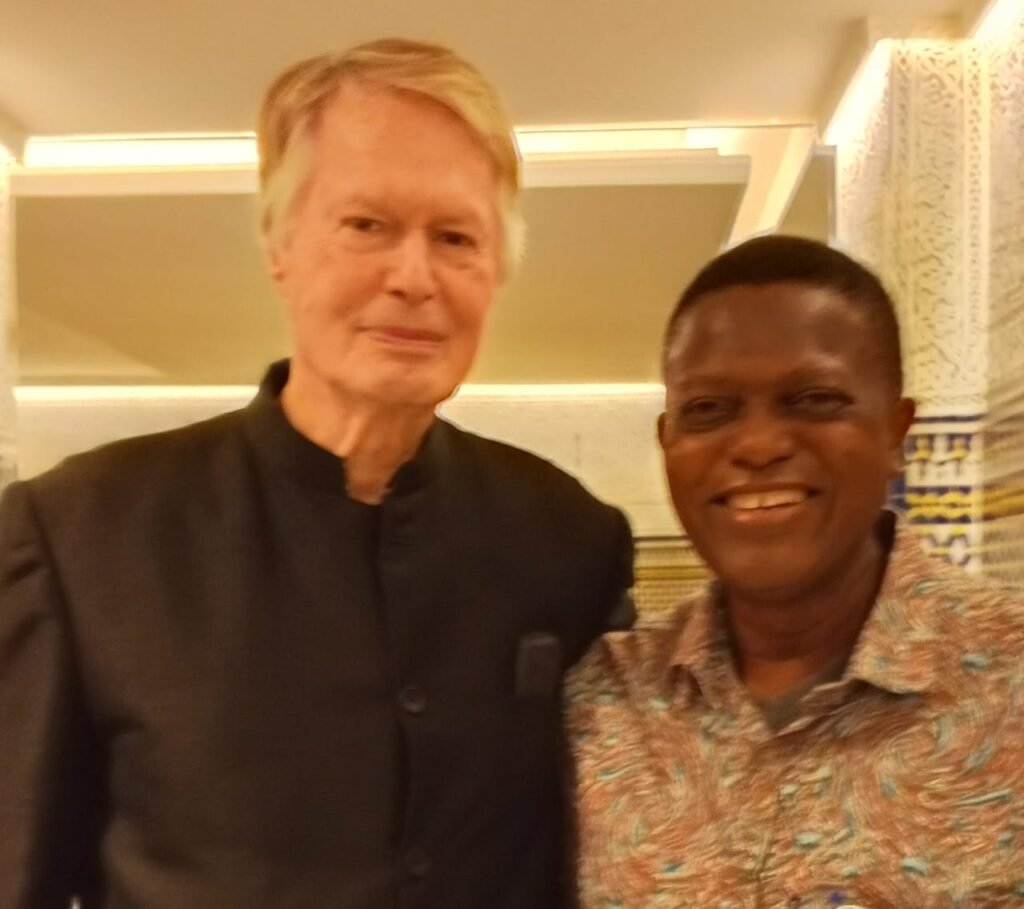
I had the good fortune of meeting Prof J.M.G. Le Clezio, the 2008 Nobel Laureate in Literature at the recently concluded ceremony for the 40th anniversary of Wole Soyinka’s Nobel Prize in Literature, which took place at the Academy of the Kingdom of Morocco in Rabat, Morocco.
Jean-Marie Gustave Le Clézio (born 13 April 1940), usually identified as J. M. G. Le Clézio, is a writer and professor who holds both French and Mauritian nationality.
The author of over forty works, he was awarded the 1963 Prix Renaudot for his novel “The Interrogation”.
He was awarded the 2008 Nobel Prize in Literature for his life’s work, as an “author of new departures, poetic adventure and sensual ecstasy, explorer of a humanity beyond and below the reigning civilization”
Le Clézio was born in Nice, his mother’s native city, during World War II when his father was serving in the British Army in Nigeria as a Medical Doctor.
He was raised in Roquebillière, a small village near Nice until 1948 when he, his mother, and his brother boarded a ship to join his father in Nigeria.
His 1991 novel ,”Onitsha” is partly autobiographical.
In addition, in his 2004 short autobiography “L’Africain”, Le Clézio reflected on his childhood in Ogoja, Nigeria from 1948 when he was 8 years old as well as his relationship with his parents.
Le Clézio began writing at the age of seven; his first work was a book about the sea.
He achieved success at the age of 23, when his first novel, The Interrogation (Le Procès-Verbal), was the Prix Renaudot and was shortlisted for the Prix Goncourt.
Since then he has published more than thirty-six books, including short stories, novels, essays, two translations on the subject of Native American mythology, and several children’s books.
In 1994, a survey conducted by the French literary magazine Lire showed that 13 per cent of the readers considered him to be the greatest living French-language writer. His works have been translated to over 30 different languages.
Le Clézio is the first French-language writer to receive the Nobel Prize in Literature since Claude Simon for 1985, and the fourteenth since Sully Prudhomme, laureate of the first prize of 1901.
During our meeting in Rabat, the Nobel laureate shared with me his strong desire to once again visit Nigeria, especially, Ogoja to recapture the melodies and memories of his childhood.