Olufemi Timothy Ogunyejo
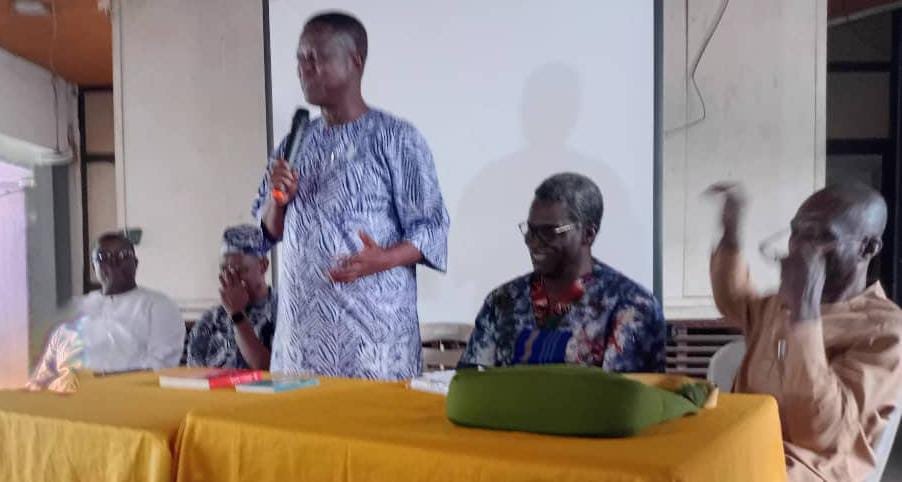
Saturday, August 15, 2026, was not just another Saturday at the University of Ibadan, Nigeria.
At the Gallery of Senior Staff Club,University of Ibadan, literature walked into the cinema, politics met scholarship, academics loosened their intellectual collars, and Dr. Wale Okediran received a warm and richly deserved salute for a literary work that has travelled from the bookshelf to the big screen.
It was an evening of books, film, scholarship, laughter, argument, friendship and celebration.
The occasion was the Ibadan Film Circle Film Screening and Discourse, organised by the Ibadan Film Circle, with the screening of Tenants of the House, the film adaptation of Dr. Wale Okediran’s acclaimed novel of the same title.
And what better place could there have been for such a gathering than the University of Ibadan?
The University of Ibadan is not merely a university. It is a landmark in Nigeria’s intellectual history, the country’s first university and one of its most important centres of scholarship, research and cultural production.
Generations of academics, writers, scientists, literary critics, artists and public intellectuals have passed through its gates and shaped Nigerian and African thought.
On this particular evening, that intellectual heritage seemed to assemble itself at the Senior Staff Club.
There was a remarkable galaxy of academic giants and distinguished personalities in attendance.
Professors, doctors, writers, filmmakers, scholars and cultural enthusiasts converged, bringing with them different disciplines, experiences and perspectives.
But this was not the kind of academic gathering where everybody sits stiffly, adjusts spectacles and waits for the next speaker to quote Aristotle.
No!
Saturday evening had its own agenda.
The atmosphere was relaxed, colourful and convivial.
Greetings flew across the room.
Old friends reunited. New acquaintances were made. Conversations developed in clusters. Laughter occasionally drowned serious discussions.
There were jokes, playful teasing, friendly arguments and the kind of intellectual banter that makes a gathering memorable.
For a few hours, the Senior Staff Club became something between a university seminar, a literary salon, a film theatre and a family reunion.
And at the heart of the evening was Dr. Wale Okediran.
The film screened was Tenants of the House, adapted from Okediran’s 2009 novel of the same title.
The book is a fictional account rooted in the author’s experience as a member of Nigeria’s House of Representatives between 2003 and 2007.
It explores the intrigues, politicking, conspiracies, corruption, betrayal and power struggles that can characterise the corridors of political power.
The film, directed by Kunle Afolayan, with screenplay by Tunde Babalola and produced by Dr. Wale Okediran, carries that political world from the printed page into moving images.
And what a journey it is!
In Tenants of the House, the action revolves around Samuel Bakura, a young and idealistic member of the House of Representatives who wants to use his position to address the long-running conflict between Fulani herders and Hausa farmers.
He sponsors a bill aimed at finding a solution to the crisis but soon encounters the complicated world of political interests, corruption, manipulation and resistance from colleagues whose priorities are far removed from public service.
The story consequently becomes much more than a political thriller.
It is about power and responsibility.
It is about what happens when public office becomes a marketplace for private interests.
It is about political ambition, corruption, betrayal, romance, gender, conflict and the struggle of the individual who attempts to do the right thing in an environment where doing the right thing can be extremely inconvenient.
The film also brings out the issue of girl-child education through the character of Lizzie and her circumstances, adding another social dimension to the political narrative.
The result is a story that entertains while asking uncomfortable questions.
Who really owns the House?
What does it mean to occupy public office?
Are elected officials truly owners of power, or merely tenants?
And if they are tenants, who are the landlords?
The title itself becomes a political metaphor. The legislators are temporary occupants of the people’s house. They come in, exercise power for a period and eventually leave. The implication is profound: public office is not personal property. That message remains remarkably relevant.
With such a gathering of intellectuals, it was impossible for the screening to end with the traditional, “Thank you for watching.”
Not at the University of Ibadan!
The film became an intellectual springboard.
The ensuing discourse opened conversations around literature, film adaptation, politics, Nigerian society, storytelling and the responsibility of creative artists.
Some viewers approached the film through the eyes of literature.
Others through politics.
Some through cinema.
Some through sociology.
Some through history.
And, naturally, some simply watched it as lovers of a good story.
That mixture was part of the magic.
The audience was not merely consuming a film; it was interrogating it.
What happens when a novel is adapted for the screen?
What does the filmmaker retain?
What does the filmmaker change?
Can a film remain faithful to a book and still become an independent artistic work?
These questions are particularly interesting in the case of Tenants of the House. Dr. Okediran himself has reflected on the tricky nature of book-to-film adaptation, noting that some changes in the film, including the fate of the main character and a scene that was not in the novel, surprised readers familiar with the book.
So, even before the discussion started, the film had already achieved something important: it had given the audience something to argue about!
A serious point would emerge.
Another scholar would offer a counterpoint.
Someone would add historical context.
Another would inject humour.
The room would erupt in laughter.
Then somebody would return everybody to the central argument.
That was the evening.
Scholarship with laughter.
Criticism with friendship.
Learning with entertainment.
In other words, pure edutainment.
The significance of the event extended beyond the screening itself.
It was a celebration of the possibilities of Nigerian literature.
For years, writers have produced novels, short stories, poems and plays that document the Nigerian experience. Yet many of these works remain confined to the world of print.
Tenants of the House demonstrates another possibility.
A literary work can travel.
A novel can become a screenplay.
A screenplay can become a film.
A film can reach audiences who may never have encountered the original book.
And those audiences can then return to the book with fresh curiosity.
That is the creative circle that the evening celebrated.
It also offered an important lesson to publishers, writers, filmmakers and academics: the boundaries between literature and other creative industries should not be walls; they should be bridges.
Dr. Okediran’s work provides a compelling example of this bridge.
The novel was first published in 2009, and the film adaptation subsequently brought its themes of politics, conflict, corruption and social responsibility to a wider visual audience.
Beyond the film itself, the evening was unmistakably an appreciation of the man behind the work.
Dr. Wale Okediran occupies an unusual and fascinating space in Nigerian intellectual and creative life.
He is a medical doctor, writer, former politician and literary personality, and his experience in the National Assembly provided an unusual vantage point from which to examine Nigerian political life.
He served in the House of Representatives from 2003 to 2007 and later became a significant figure in the Nigerian literary community.
That combination of medicine, politics and literature makes his creative journey particularly interesting.
He has experienced society from different rooms.
The hospital.
The parliament.
The literary world.
And, through film, the cinema.
Perhaps that is why Tenants of the House possesses such a distinctive texture. It is not simply political imagination invented from a distance; it draws upon lived experience and transforms that experience through fiction.
Scholars have described the novel in terms of faction, the blending of fact and fiction to represent social and political realities.
His literary work therefore deserves celebration not merely because it entertains but because it provokes reflection on the African condition.
But if the intellectual content gave the evening its substance, the atmosphere gave it its soul.
The Senior Staff Club was alive.
There was colour in the room.
There was the excitement of old acquaintances meeting again.
There were photographs.
There were smiles.
There was laughter.
There were side conversations that were probably almost as interesting as the official discourse.
There were moments when a scholar made a serious observation and someone else transformed it into a joke.
There were moments of teasing.
There were moments of nostalgia.
There were moments of admiration.
And there were moments when everybody simply sat back and enjoyed the evening.
That distinction matters.
Sometimes intellectuals need to relax.
Sometimes professors need to laugh.
Sometimes writers need to listen.
Sometimes filmmakers need to defend their choices.
And sometimes everybody simply needs a good story.
Saturday August 16, 2026 evening provided all of these.
The choice of the University of Ibadan also added an important symbolic dimension.
A university is not merely a place where degrees are only awarded. It is a place where society interrogates itself.
That was exactly what happened at the Senior Staff Club.
Through Tenants of the House, Nigeria looked at itself in the mirror.
The film asked questions about leadership.
It questioned political morality.
It examined the consequences of corruption.
It explored the difficulties of conflict resolution.
It touched on gender and education.
It portrayed the temptations that accompany power.
And it reminded the audience that those who occupy public office are ultimately accountable to the people.
The film’s political narrative is particularly anchored in the conflict between herders and farmers and the struggle to find a peaceful solution amid political interests and corruption.
Those are not abstract issues.
They are questions that have shaped Nigeria’s and to some extent, the national conversation of some African countries for years.
By the end of the evening, it was clear that the gathering had achieved something beyond entertainment.
It had brought together literature, film, politics, scholarship and social commentary in one space.
And it had shown that celebrating a writer can also mean celebrating an entire creative ecosystem.
For Dr. Wale Okediran, the honour was therefore well deserved.
His Tenants of the House has moved through several lives: first as a novel, then as a subject of literary criticism, and later as a film capable of reaching a much broader audience.
It is a work that refuses to sit quietly.
It provokes.
It entertains.
It questions.
It unsettles.
It educates.
And, most importantly, it invites Africans to think about the kind of society they are building.
There was the memory of a gathering.
The memory of eminent scholars exchanging ideas.
The memory of laughter breaking through academic seriousness.
The memory of jokes and gentle teasing.
The memory of spirited discussions.
The memory of a film provoking questions.
The memory of literature finding another life on screen.
The Ibadan Film Circle deserves commendation for creating the platform for this meeting of minds, while the Senior Staff Club of the University of Ibadan provided a fitting intellectual and social setting for the occasion.
Ultimately, Saturday, August 15, 2026, will be remembered as one of those beautiful evenings when the University of Ibadan once again proved that knowledge does not live only in lecture rooms and libraries.
When academic giants gathered to honour Dr. Wale Okediran’s literary work in film, they did more than watch Tenants of the House. They celebrated the writer, interrogated the story, debated the politics, appreciated the art, and, importantly, had a thoroughly enjoyable evening doing it.